Iberico vs Serrano Ham: What's the Difference (and Which to Buy)?
Serrano and Ibérico are both Spanish cured hams, but the pig, the diet, the curing time and the price differ. How to tell them apart and when to buy each.
Heads up: this guide contains affiliate links. If you buy through them we may earn a small commission, at no extra cost to you. We don't accept free products or paid placements. How we choose products.
It’s the most common question about Spanish ham, and the answer is simple: they come from different pigs. Serrano comes from white pigs; Ibérico from the black Iberian breed. Everything else — the flavor, the fat, the curing time and the price — follows from that.
The quick answer
- Serrano is Spain’s everyday ham: white pigs, fed on grain, cured for months. Good for sandwiches and cooking.
- Ibérico is the premium ham: Iberian pigs, cured for years. The best, bellota, comes from pigs that roamed oak forests eating acorns.
- If you want to taste what makes Spanish ham famous, buy Ibérico. If you want a good ham for every day, Serrano is the smart choice.
Side by side
| Jamón Serrano | Jamón Ibérico | |
|---|---|---|
| Pig | White breeds (Duroc, Landrace, Large White crosses) | Iberian breed, at least 50% (100% for the best) |
| Diet | Feed and cereals | Feed; pasture and feed; or acorns in the montanera season (bellota) |
| Minimum curing | 7 months (210 days) for the EU “Serrano” specialty | About 2 years: 600 days, or 730 for legs of 7 kg or more |
| Fat | Less, firmer, whiter | Marbled through the meat, melts at room temperature |
| Flavor | Savory, salty, clean | Deep, nutty, sweet, long-lasting |
| Label | “Jamón Serrano”, often with the ETG/TSG seal | A colored tag: black, red, green or white |
| Price | Everyday | Several times more; bellota is the most expensive |
What Serrano is
“Serrano” means “from the mountains”, where hams were traditionally cured in cold, dry air. Today it’s the ham in most Spanish kitchens and bars. The name is protected in the EU as a Traditional Speciality Guaranteed (TSG, ETG in Spanish): the ham must come from white pigs and cure for at least 210 days.
Some white-pig hams go further, like Jamón de Teruel (a PDO) or Jamón de Trevélez (a PGI), which cure longer and are well worth trying. But no Serrano is ever Ibérico.
What Ibérico is
Ibérico ham comes from the Iberian pig, a breed native to southwestern Spain and Portugal. Spanish law sets four categories, each with a color tag:
- Black: de bellota 100% ibérico. Purebred, acorn-fed. The only ham that may be called “pata negra”.
- Red: de bellota ibérico. Acorn-fed, crossbred (usually 50% or 75% Iberian).
- Green: de cebo de campo ibérico. Raised outdoors, fed on pasture and feed.
- White: de cebo ibérico. Raised on farms, fed on feed.
The acorns and the outdoor life are why bellota fat is so soft and aromatic. → The label colors explained

Cinco Jotas Hand-Carved Jamón Ibérico de Bellota (3 oz)
Cinco Jotas (5J) · Jabugo, Huelva · Pre-sliced, hand-carved style, vacuum pack
The benchmark most Spaniards would name first. Jabugo style: intense, long, savory. Buy it when you want the 'this is why people rave about it' moment — not for a big party.
Why we like it
- The reference brand in Spain
- Hand-carved style slices
- Intense Jabugo flavor
Keep in mind
- Premium price for 3 oz
- Too strong for some first-timers
Best for: A first taste of the top tier, a special gift
Price and availability on Amazon.com
How they taste
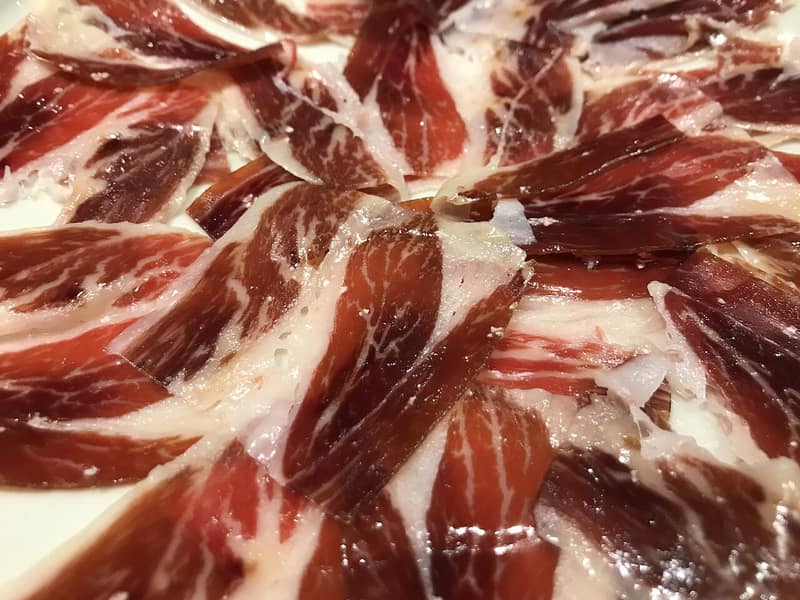
Put a slice of each side by side and the difference is obvious. Serrano is firmer, saltier and more straightforward, a bit like a good prosciutto. Ibérico bellota is darker red, glossy with fat, and the flavor keeps going: nuts, sweetness, a long finish. The fat of a bellota ham starts to melt on your fingers.
Fermín 100% Ibérico Acorn-Fed Ham, sliced (2 × 2 oz)
Fermín · La Alberca, Salamanca · Pre-sliced, 2 small packs
Fermín was the first Spanish producer cleared to export Ibérico pork to the US, and it's the brand you'll find most consistently in stock. Salamanca style: rounder and gentler than Jabugo — an easy first bellota.
Why we like it
- Most reliable stock in the US
- Gentle, sweet Salamanca style
- Small packs: no waste
Keep in mind
- Machine-sliced look, less 'bar-like'
Best for: First-time buyers, reliable availability
Price and availability on Amazon.com
COVAP 100% Ibérico de Bellota Ham, sliced (2 oz)
COVAP · Los Pedroches, Córdoba (PDO) · Pre-sliced, 2 oz pack
A cooperative from Los Pedroches, one of Spain's four Ibérico PDOs and the least known in the US. Good to taste side by side with a Jabugo or Salamanca ham.
Best for: Comparing origins, curious eaters
Price and availability on Amazon.com
When to buy which
| For… | Buy |
|---|---|
| Eating on its own, as the star of a board | Ibérico, ideally bellota |
| A gift | Ibérico bellota (black or red label) |
| Sandwiches (bocadillos), kids, everyday snacks | Serrano |
| Cooking: croquetas, stews, topping salmorejo | Serrano, or the ends of an Ibérico leg |
| A party where people will eat a lot | Serrano for volume, one pack of Ibérico to taste |
Three myths to ignore
- “Pata negra” means any black hoof. The hoof color proves nothing on its own; legally, “pata negra” is reserved for 100% Ibérico bellota (black label).
- “Ibérico” on the label means acorn-fed. Only “de bellota” means acorns. A white-label Ibérico was fed on feed.
- Serrano is a lesser copy. It’s a different, honest product. A good Serrano beats a cheap Ibérico for many uses.
Keep reading
→ 7 mistakes Americans make with Iberico ham · Is Iberico ham worth the price? · Where to buy it in the US
Sources: Spain’s Ibérico quality standard (Real Decreto 4/2014, BOE) · Spanish Ministry of Agriculture: the Ibérico standard